Signs of Hidden Mold: What to Look For When You Cannot See Any
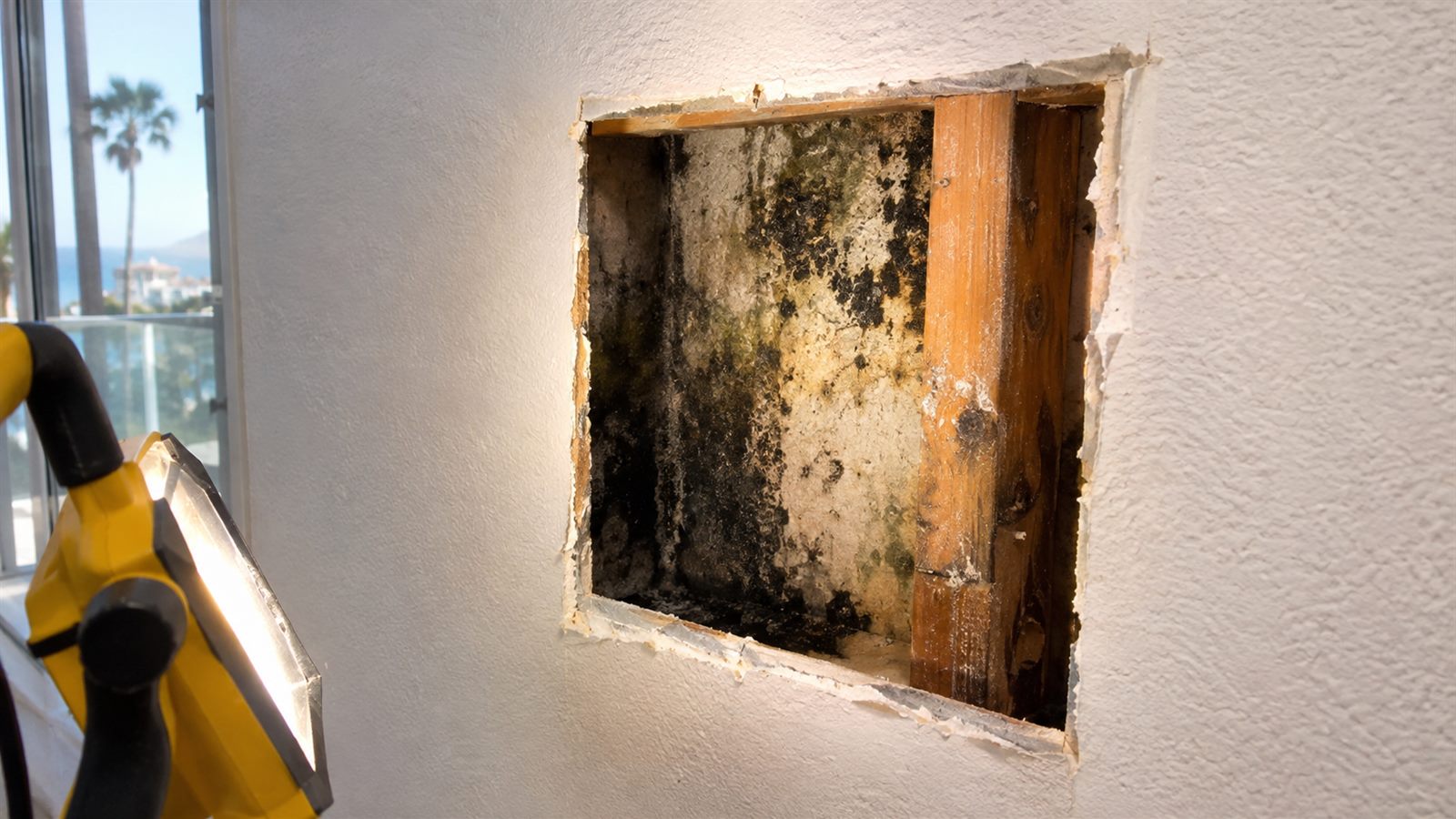
Most of the mold in a San Diego home with a moisture problem is not on a surface you can look at. Here is how to find it without taking the house apart.
Quick answer
How do you find mold you cannot see? Follow the three signals that do not require visibility: a musty smell that cleaning does not remove, symptoms that change with location or with the HVAC running, and material that reads wet on a moisture meter. Then look in the four places San Diego hides it — the crawl space, the wall cavity behind wet rooms, the attic above bathrooms, and the duct system. A moisture-mapped inspection with thermal imaging and cavity access locates it without exploratory demolition.
Signal one: the smell
A persistent musty, earthy odor comes from microbial volatile organic compounds produced by actively growing mold. It is the most reliable indicator of hidden growth, and it is the one people most often dismiss.
What to pay attention to:
- Where it is strongest. Walk the house slowly and note the room, and within the room the corner or closet.
- When it is strongest. Morning, after the house has been closed overnight, is usually the peak — particularly at the coast.
- Whether it appears when the HVAC starts. If the odor arrives within a minute of the blower starting, the source is in the system or in the space the system draws from.
- Whether you stop noticing it. Olfactory adaptation is real. Ask someone who does not live there — they will smell what you no longer can.
Signal two: the pattern of symptoms
Symptoms cannot diagnose mold, but their pattern can point at the building. Worse at home and better after a few days away. Worse on waking. Worse in one room. Worse when the heating or air conditioning runs. More than one household member affected the same way. Started after a water event, a remodel or a re-roof.
Two or more of those together is enough reason to investigate the building. See mold and health: what the evidence supports for what the evidence does and does not support.
Signal three: the building is telling you it is wet
- Paint or stucco bubbling, blistering or peeling in one defined area.
- Baseboard swollen, separated from the wall, or lifted off the floor — especially on a wall with no plumbing above.
- Flooring that cups, lifts, buckles or feels soft.
- Tile that sounds hollow or moves, particularly the bottom course in a shower.
- A warm spot on a slab floor, or a water meter that creeps with everything off.
- Doors or windows that have started to stick in one part of the house.
- Condensation on windows that was not there before.
- An unexplained increase in the water bill.
The four places San Diego hides it
1. The crawl space. In any pre-1950 raised-floor home — North Park, Ocean Beach, Golden Hill, La Mesa Village, Old Town National City, Old Escondido, South Oceanside — this is the first place to look. Blocked foundation vents and end-of-life cast-iron drains. Crawl space air moves upward into the living space, which is why the smell reaches you.
2. The wall cavity behind wet rooms. Behind shower walls and under pans, under sinks, behind dishwashers and refrigerators, behind washing machines. The tile and cabinetry look fine from outside.
3. The attic above bathrooms. Where an exhaust fan terminates inside the attic rather than through the roof, every shower deposits moisture on the roof deck. Diffuse growth across sheathing, directly above the bathroom.
4. The duct system and air handler. In San Diego these are usually in a crawl space, attic or garage. A blocked condensate drain, a wet coil, or return-side leakage pulling in humid unconditioned air. The tell is a musty smell tied to the system running.
How professionals locate it without demolition
- Moisture mapping. Pinless meters sweep surfaces to find anomalies; pin meters confirm actual moisture content. A dry standard is established from unaffected material of the same type so readings mean something.
- Thermal imaging. An infrared camera shows the evaporative cooling pattern of wet material behind a finish. It does not see moisture directly, so every thermal finding is confirmed with a meter.
- Psychrometrics. Indoor and outdoor temperature, relative humidity and dew point, logged over days. This is how a condensation problem is distinguished from a leak, which matters enormously in San Diego.
- Borescope through a small hole. A patchable penetration and a camera answers visually what is inside a wall or floor assembly.
- Cavity air sampling. A sample drawn from inside the assembly, which directly answers whether there is growth in there. In San Diego's stucco-over-frame and raised-floor construction this is often the single most useful test you can buy.
What not to do
Do not start cutting holes. Opening a colonised cavity without containment releases spores through the house and turns a localised problem into a building-wide one. If you are going to open anything, get it mapped first so you open in the right place, once.
Do not buy a home test kit. Settle plates will grow something anywhere, give no outdoor comparison, and produce a frightening result with no actionable information.
Do not assume an air purifier is addressing it. A purifier filters the room it is in. It does not reach inside a wall, a floor, a crawl space or a duct.
The two instruments worth owning, and what each one settles
Together they cost less than a single air sample and they answer the two questions that actually separate a humidity problem from a leak.
A hygrometer, about $15. Leave it in the suspect room for a week, near the suspect wall, at the height of the problem rather than in the hallway. Sustained relative humidity above roughly 60% means cool surfaces in that room are at or below the dew point of the air touching them, and growth needs no leak at all. This is the normal coastal San Diego finding, and it is a ventilation and dehumidification problem.
A pinless moisture meter, $30 to $60. Read the suspect wall, then read the same material somewhere unaffected in the same building. The second reading is your dry standard; the first is only meaningful against it. A materially elevated reading means liquid water in the assembly, which no amount of dehumidification will fix — you are looking for a source.
The combination is diagnostic. High humidity with a normal wall reading is condensation. A normal room with an elevated wall reading is a leak. Both elevated usually means a leak that has been running long enough to load the room air as well.
Reading the smell: what the timing of an odour tells you
The microbial volatile organic compounds that produce a musty smell are detectable at concentrations far below anything a household instrument measures, which makes your nose the most sensitive tool in the building. The useful information is in the timing rather than the intensity.
Strongest on waking, before the house is opened. Overnight accumulation in still air. Points at a source in or near that room, and it is the pattern most often reported in coastal bedrooms.
Arrives within a minute of the blower starting and fades when it stops. The system is the source or is distributing it. Treating the rooms without the air handler means it returns on the next cycle.
Strongest near floor penetrations, registers or at the base of walls. In a raised-floor house, that is air arriving from the crawl space, and the crawl space is where the investigation belongs.
Strongest after rain, for a few days, then fading. An envelope defect that only takes water under particular conditions — usually a window head detail or a roof-to-wall junction on the weather elevation.
Constant, everywhere, unchanged by anything. Often not mold. Consider a dry P-trap, a sewer vent issue, or a crawl space or attic that has an animal problem rather than a moisture problem.
The complete checklist: eighteen indicators, in order of how often they turn out to be mold
Read the first column if you have something to look at. Read the second if you have a smell, a bill or a meter reading and nothing else. Read the third if the building looks fine and the only evidence is how people feel in it. Most confirmed cases we see started in the second or third column, not the first.
What you can see
- Discoloration that returns after painting
- Paint does not stop mold. A stain that reappears within weeks means the material behind it is still wet and the organism is still alive in the substrate. Look at bathroom ceilings, the wall behind a shower, and the bottom 12 inches of walls in slab homes.
- Swollen, lifting or separating baseboard
- MDF and finger-jointed pine swell visibly when the bottom edge absorbs water. The telling version is baseboard damage on an interior wall with no plumbing fixture nearby — that is a slab leak surfacing far from the break.
- Bubbling or blistering paint and stucco
- Moisture moving through the substrate from behind. On exterior stucco, follow it upward: in San Diego's stucco-over-frame walls, water enters high at a window head or a missing kick-out flashing and surfaces low.
- Flooring that cups, lifts or feels soft
- Hardwood cupping along one wall line, vinyl lifting at a seam, tile that sounds hollow at the bottom course of a shower. All indicate the subfloor or slab beneath is wet.
- Dark diffuse growth on attic sheathing
- Spread across the deck rather than radiating from one point. That pattern is condensation, not a roof leak — almost always a bathroom fan terminating in the attic or soffit intake buried under blown insulation.
- Visible colonies on a wet cellulose surface
- Dark green-black growth on soaked drywall paper, cardboard, framing or ceiling tile. On cellulose this usually means weeks of continuous saturation, so the affected area is larger than what you can see.
What you cannot see, but can measure or smell
- A musty smell with nothing visible
- The single most reliable indicator of hidden growth. The odour is microbial volatile organic compounds from an actively growing colony, which means a wall cavity, a floor assembly, the crawl space or the duct system. In a raised-floor home it reaches you through floor penetrations; the smell is usually strongest in the morning and in the lowest rooms.
- A smell that arrives when the system starts
- If the odour appears within a minute of the blower starting and fades when it stops, the source is in the air handler, the condensate pan or the duct run — which in San Diego normally sits in a crawl space, an attic or a garage.
- A warm patch on a slab floor
- Walk the floors barefoot early, before sun or heating warms the concrete. A distinctly warm spot means a hot-water-side slab leak is heating the slab locally.
- A water meter that moves with everything off
- Shut every tap, appliance, irrigation valve and ice maker, then watch the meter's low-flow indicator for ten minutes. Any movement means water is escaping into the building or the ground. This costs nothing and catches most slab leaks.
- A step change in the water bill
- Pull twelve months. A jump at one billing period that never came back down, with no change in use, is strong evidence of a concealed leak rather than a habit.
- Humidity that stays above 60%
- A $15 hygrometer tells you more than your eyes. Sustained indoor relative humidity above about 60% means cool surfaces — closet walls, the back of furniture against an exterior wall — are reaching a surface humidity that supports growth with no leak at all. That is the normal coastal San Diego condition from May to September.
When there is nothing to see at all
- Worse at home, better away
- Congestion, cough or irritation that eases within a few days of being elsewhere and returns when you come back. This is the clearest building-related pattern.
- Worse on waking
- Symptoms heaviest in the morning after a night in the building, easing through the day.
- Worse in one specific room
- Which narrows the search immediately — and is worth noting before any inspection.
- Worse when the heating or air conditioning runs
- Points at the duct system or at a source the system is distributing to every room.
- More than one person in the household affected the same way
- Shared exposure rather than individual illness.
- Started after a specific event
- A leak, a storm, a remodel, a re-roof, a new appliance, or a season change. Dampness and mold are associated with upper and lower respiratory symptoms, cough, wheeze and worsening of existing asthma — take symptoms to a physician, and the building to a moisture-mapped inspection. They are two different questions.
No single item on this list proves mold. Two from different columns almost always means a moisture source that has been running long enough to matter, and that is the point at which measurement beats guessing.
Frequently asked questions
Can mold grow with no water leak at all?
Yes, and in coastal San Diego it is common. Where outdoor relative humidity sits above 80 percent for months and a home has no air conditioning or dehumidification, cool interior surfaces reach a surface humidity high enough for growth with no liquid water involved. Closets on north-facing exterior walls, the backs of furniture, wardrobes and leather goods are where it appears first. The fix is humidity control rather than a repair.
How much does it cost to find hidden mold?
A full mold and moisture inspection with moisture mapping, thermal imaging, psychrometric logging and a written report typically runs $250 to $600 in San Diego, and cavity air sampling adds a further $100 to $200 per sample including accredited lab analysis. Both are indicative ranges rather than quotes. That is almost always cheaper than the exploratory demolition people do instead, and it is far cheaper than opening the wrong wall.
I found it. Should I open it up myself to see how bad it is?
No. That is the moment to stop. Cutting into a colonised cavity without negative-pressure containment distributes spores through the house and into the HVAC system, and it also destroys the documentation you may need for an insurer, a landlord or an HOA. You will also almost certainly misjudge the boundary without a moisture meter. Photograph what you have, leave it closed, and get it scoped.
Is there a test that finds mold inside a wall without opening it?
Cavity air sampling comes closest: a sample drawn from inside the assembly through a small penetration, compared against a simultaneous outdoor control. It answers whether there is growth in that specific cavity. Thermal imaging and moisture meters find the water rather than the growth, which for deciding what to do is usually the more useful answer.
I can smell it but three people have found nothing. What now?
Change what is being looked for. Ask for the moisture question rather than the mold question: psychrometric readings indoors and out, a meter survey of wall bases and under windows against a stated dry standard, the crawl space and the attic, and where the bathroom and dryer ducts actually terminate. Most persistent smells with nothing visible resolve into one of those.
Related reading
- mold inspection and testing in San Diego
- crawl space mold removal in San Diego
- black mold warning signs in San Diego
- mold inspection vs mold testing
Need help with this in San Diego? We provide Mold Inspection and Testing in San Diego across all 34 service areas. Free phone consultation, 24/7 — (858) 400-3506.