Types of Mold Found in San Diego Homes — and What Each One Tells You
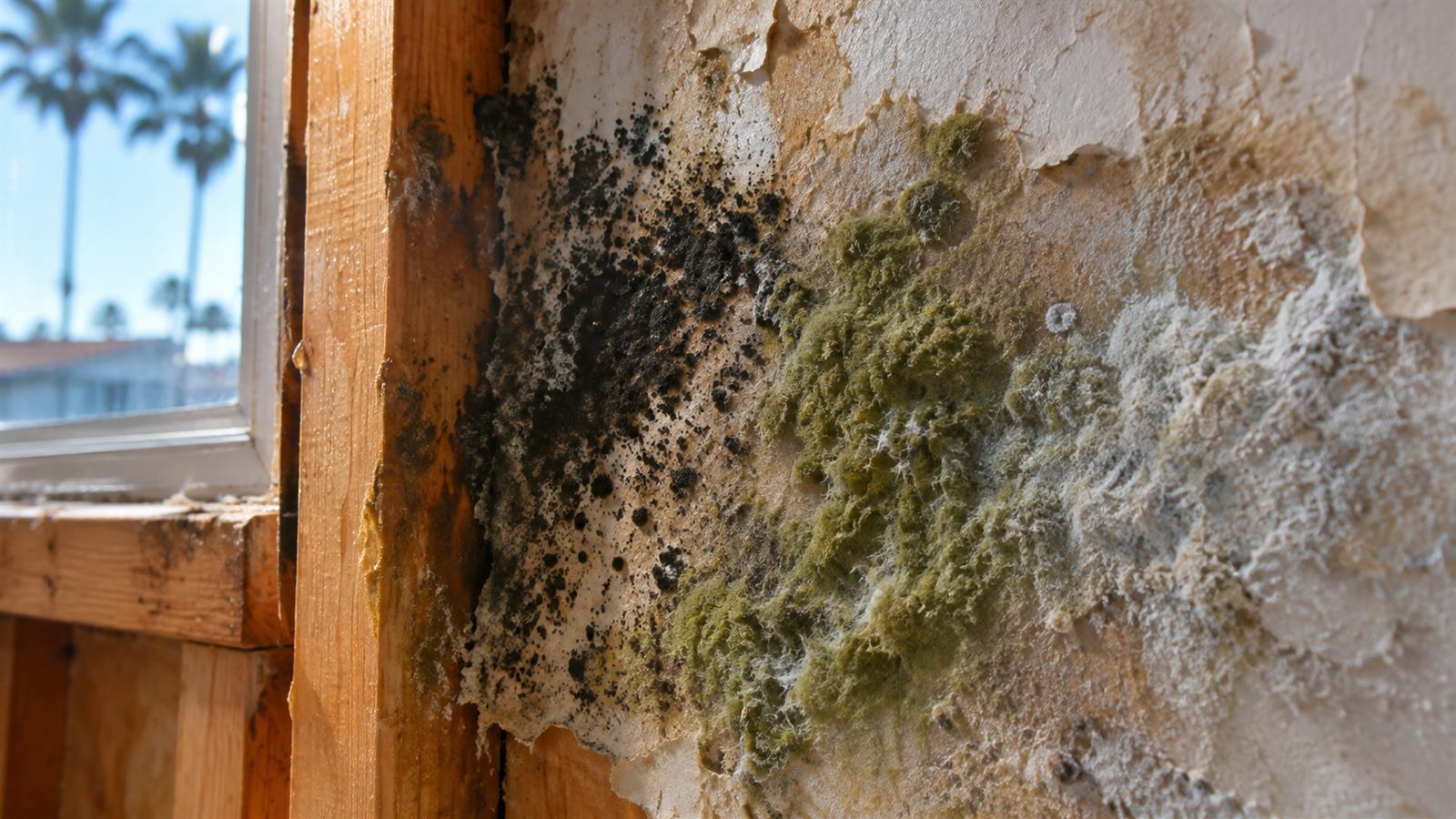
Identifying the genus rarely changes what has to be removed. What it does change is what you learn about the water: how wet, for how long, and whether the source is still active.
Quick answer
What types of mold are common in San Diego homes? The most common are Cladosporium (dark, extremely common, tolerates moderate humidity), Aspergillus and Penicillium (reported together by most labs, the dominant indoor genera in humid coastal homes), Alternaria (damp bathrooms and window frames), and in prolonged saturation Stachybotrys chartarum and Chaetomium. Which one you have tells you about the moisture history; it rarely changes the remediation protocol.
Cladosporium: the baseline
Dark green, brown or black, velvety or powdery, and the most commonly identified mold both indoors and outdoors worldwide. It tolerates relatively moderate moisture, which means in coastal San Diego it can grow on surfaces kept damp by ambient humidity alone — window sills, painted bathroom ceilings, the back of a closet wall, leather and fabric in a wardrobe.
What it tells you: usually a humidity and ventilation problem rather than a leak. It is the most common thing homeowners photograph and call black mold.
Aspergillus and Penicillium: the indoor dominants
Most laboratories report these two together as Aspergillus/Penicillium because their spores are difficult to distinguish on a spore trap. They appear in a wide range of colours — blue-green, grey-green, yellow, white — often as a powdery or fuzzy patch, and they are the genera most often elevated in indoor air samples from homes with a moisture problem.
They grow readily on drywall paper, wallpaper paste, carpet, insulation, dust and food. Aspergillus niger presents as black and is frequently mistaken for toxic black mold.
What it tells you: a sustained indoor moisture condition. An indoor air sample heavily dominated by Aspergillus/Penicillium against a low outdoor control is one of the clearer indicators of hidden indoor growth.
Alternaria: bathrooms, windows and condensation
Dark grey-brown to black, with a wool-like or velvety texture. It needs more moisture than Cladosporium and typically turns up where condensation is persistent: shower and tub surrounds, window frames and sills, under sinks, around poorly ventilated bathroom fixtures.
What it tells you: repeated wetting and poor drying. In San Diego it is a near-reliable indicator of a bathroom with no working exhaust, or of single-pane windows condensing during inland winter inversions.
Stachybotrys and Chaetomium: the duration markers
Stachybotrys chartarum is dark greenish-black and often slimy or wet-looking. Chaetomium is dark and becomes cottony as it matures. Both require cellulose material — drywall paper, cardboard, wood, ceiling tile — that has been continuously wet for weeks or longer.
What it tells you: this is the valuable part. Finding either one means the water has been present for a long time, which has three consequences. The affected area is almost certainly larger than what is visible. The source may well still be active. And for an insurance claim it raises the sudden-versus-gradual question that decides coverage, so the documentation matters.
In San Diego we find these most often behind slab-leak wall bases, under failed shower pans, in crawl spaces with failed cast-iron drains, and behind drywall that was flooded and dried in place rather than removed.
Why the protocol does not change
The California Department of Public Health's guidance is that visible indoor mold and the dampness causing it should be addressed regardless of the species present, because the adverse health effects are associated with dampness and mold generally rather than with any single organism. The US EPA's practical guidance is the same.
So the containment design, the removal boundary, the drying standard and the verification method do not change based on the lab result. A dark colony on wet drywall is removed under containment whether it is Stachybotrys or Aspergillus niger. Which is why a species panel is information you should buy when you will act on it — a dispute, a claim, a medical question — and skip when you will not.
What about the mold you cannot see?
Most of the mold in a San Diego house with a moisture problem is not on a surface you can look at. It is on the back of drywall, on the underside of subfloor sheathing, inside a shower wall, on roof-deck sheathing above a bathroom, or on the soil-side face of crawl space joists.
That is the argument for moisture mapping over species testing. The genus of what you can see tells you about conditions; the moisture map tells you how much of the house is affected. See mold inspection vs mold testing.
Which genera actually turn up in San Diego, and in which part of the house
Cladosporium is the most frequently identified genus in coastal California homes. It tolerates cool, damp surfaces, which is exactly what the marine layer produces, and it is the usual answer on closet walls, window reveals and the back of furniture in Ocean Beach, Pacific Beach and Imperial Beach houses with no air conditioning.
Penicillium and Aspergillus dominate wet cellulose — drywall paper, the back of wallpaper, carpet pad, cardboard stored in a garage. These are the genera a lab usually reports after a contained leak, and they are also the ones most often behind a musty smell with nothing visible, because they grow happily inside a wall cavity.
Alternaria shows up around sinks, showers and window condensation lines. Chaetomium and Stachybotrys need material that has been genuinely saturated for days, which in San Diego means a slab leak that ran for months, a supply line failure, or the January 2024 flood corridors — not ordinary humidity.
Aureobasidium on exterior stucco and window frames is extremely common on the coast and is largely cosmetic weathering rather than an indoor air problem.
What a spore count means, and the outdoor control that makes it readable
An air sample gives spores per cubic metre by genus. On its own that number is unreadable, because outdoor air in San Diego carries a substantial background load that changes with the season, the wind and whether anything has been mowed nearby. A result is interpretable only against a simultaneous outdoor control taken the same day at the same property.
What matters is the comparison, not the absolute figure. Indoor levels similar to outdoors, with a similar mix of genera, suggests normal infiltration. Indoor levels markedly higher than outdoors, or a genus present indoors and absent outdoors, suggests an indoor source. A high count of a genus that is also high outside usually means a window was open.
This is why a single indoor sample with no control is close to worthless, and why a clearance test after remediation is the one sampling scenario that reliably earns its fee.
The part the species does not decide
Containment design, the removal boundary, the drying standard and the verification method are the same across every genus above. IICRC S520 sets the protocol by condition and by the size of the affected area, not by organism. California Department of Public Health guidance takes the same position: remediate dampness and mold regardless of species.
What the species does sometimes change is the conversation. A lab report naming Stachybotrys moves an HOA or a landlord faster than the same report naming Cladosporium, even though the remediation is identical. That is a negotiation reality, not a technical one, and it is worth knowing which of the two you are paying for.
Frequently asked questions
Should I get the mold identified before removing it?
Only if you will act on the answer. Useful cases: a dispute with a landlord, insurer or HOA; a physician has asked for it; or a legal matter. Not useful: your own home, visible growth, known water source, and you simply want it gone. In that case the money is better spent on a thorough moisture-mapped inspection that defines the real boundary.
Is any mold in a house normal?
Mold spores are present in every building on earth and that is normal — they come in with outdoor air every time a door opens. What is not normal is active growth on building materials, which requires sustained moisture. The professional term for the target condition is normal fungal ecology: spores present at levels comparable to outdoors, with no indoor growth.
Does mold colour tell you anything?
Less than people think. Many genera appear in several colours depending on the substrate and the stage of growth, several unrelated organisms appear black, and some non-fungal staining looks exactly like mold. What is more informative than colour is substrate and wetness: a dark colony on soaked drywall paper or cardboard tells you a great deal, while the same colour on a dry painted surface may be soot, mineral staining or dirt.
Is one type of household mold more dangerous than the others?
Public-health guidance in California and at the EPA does not rank household mold that way. The documented associations — upper and lower respiratory symptoms, cough, wheeze and worsening of existing asthma — attach to dampness and mold generally rather than to a single organism, which is why the remediation protocol does not change with the species.
Do I need a lab test to know what kind of mold I have?
Only if a specific decision depends on the answer: a legal or insurance record, a physician's request for a vulnerable occupant, or clearance after remediation. If mold is visible and the water source is known, a species panel is information you will pay for and not act on.
Related reading
- mold inspection and testing in San Diego
- black mold removal in San Diego
- mold vs mildew: the real difference
- black mold warning signs in San Diego
Need help with this in San Diego? We provide Mold Inspection and Testing in San Diego across all 34 service areas. Free phone consultation, 24/7 — (858) 400-3506.