DIY vs Professional Mold Removal: Where the Line Actually Is
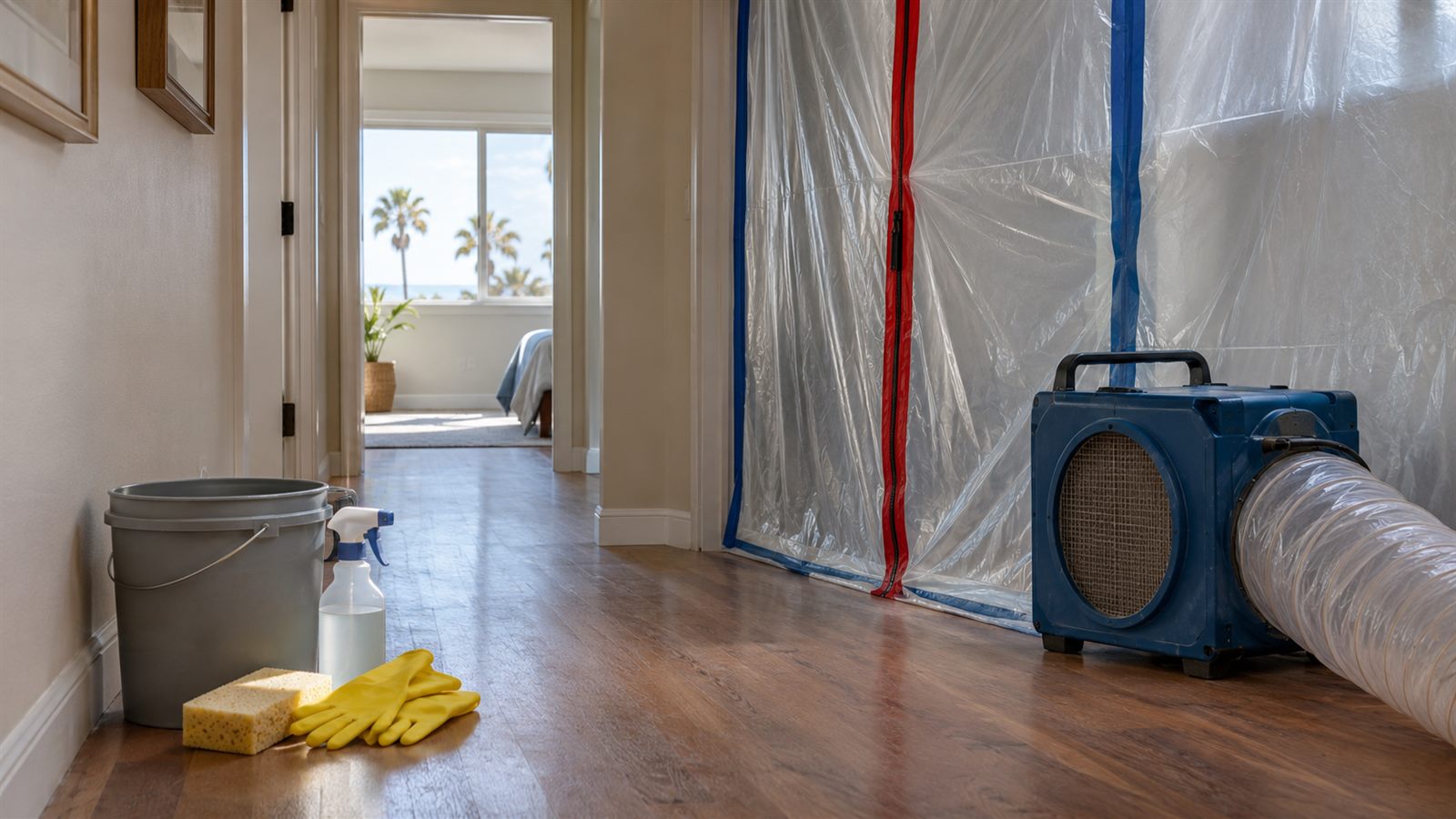
Plenty of mold is yours to clean. The problem is that the two things that make DIY fail — spreading spores during demolition, and stopping short of the real wet boundary — are both invisible while you are doing it.
Quick answer
Can I remove mold myself? Yes for a small, well-defined area — roughly under ten square feet, on a non-porous surface, where you have already fixed the water source. Use an N95 respirator, gloves, eye protection and detergent. No for anything inside a wall, under flooring, in a crawl space or attic, after contaminated water, over ten square feet, or where anyone in the household is asthmatic, immunocompromised, elderly or an infant.
What you can reasonably do yourself
- Surface growth on tile, glass, sealed stone, metal and glossy painted surfaces.
- Mildew on shower grout and silicone, where the substrate is sound.
- Light surface growth on a hard-surface window sill or frame.
- Mold on washable fabric, which goes in a hot wash.
- Surface growth on an exterior stucco or fence surface.
Method: N95 respirator, nitrile gloves, eye protection. Detergent and warm water with a stiff brush or cloth, then dry thoroughly. Ventilate the room to the outside if outdoor humidity allows. Dispose of cloths in a sealed bag.
Do not use bleach, and here is why
Bleach is the reflex and it is the wrong tool for most mold.
- Household bleach is largely water. Applied to drywall, wood or grout you are adding moisture to exactly the material you need to dry.
- The chlorine does not penetrate porous material, so it bleaches the visible stain while leaving the mycelium alive in the substrate below. The growth returns, often looking like a new problem.
- Killing mold does not remove it. Dead spores and hyphal fragments remain allergenic, which is why the professional standard is physical removal rather than chemical treatment.
Detergent and physical scrubbing outperforms bleach on cleanable surfaces, and nothing you can spray fixes porous material.
Where you should stop
- Anything inside a wall, ceiling or floor assembly. Opening a colonised cavity without containment releases an enormous number of spores into the rest of the house. This is the single most common way a $2,000 job becomes a $7,000 job.
- More than about ten square feet. That is the rough threshold the EPA uses as well, and it reflects the point where containment and engineering controls start to matter.
- Crawl spaces and attics. Confined space, poor air, and the air you disturb moves straight into the living space through floor penetrations and duct leakage.
- After category 2 or 3 water. Grey or black water means contamination as well as mold, different protective equipment, and removal rather than cleaning.
- Any HVAC component. Cleaning a contaminated coil, plenum or duct without isolating the system distributes it to every room.
- Vulnerable occupants. Infants, elderly people, anyone with asthma or chronic respiratory disease, and anyone immunocompromised.
The two failures that make DIY expensive
Cross-contamination. Cutting into a wet wall cavity releases spores at concentrations orders of magnitude above background. Without negative pressure and HEPA filtration, those spores settle throughout the house and into the HVAC system. You have turned a localised problem into a building-wide one, and the remediation that follows is larger than the one you were avoiding.
Stopping short of the boundary. Without moisture meters you cannot know where the wet material ends. People cut back to where the staining stops, which is reliably inside the actual wet boundary. The remaining material is still wet, still colonised, and now sealed behind new drywall. It surfaces again within a year.
What professional work buys you that you cannot replicate
- A source diagnosis. Moisture mapping and thermal imaging that tell you where the water came from and how far it went — which is the thing that decides whether the problem recurs.
- Containment. Negative pressure and HEPA filtration so demolition does not contaminate the rest of the building.
- Drying capacity. Commercial LGR dehumidifiers remove many times the water per day of a consumer unit, and the drying is measured against a dry standard rather than guessed.
- Documentation. Photographs, daily moisture logs and verification — which is what an insurer, a buyer's inspector, a landlord or an HOA board will ask for later.
An honest middle path
You do not have to choose between doing everything and buying everything. A reasonable split that we recommend regularly:
- Pay for the inspection. $250 to $600 buys you a moisture map and a source determination, and tells you what you are actually dealing with. Many companies, including us, credit it against the work if you proceed.
- If the finding is surface growth with an identified ventilation cause, clean it yourself and spend the money on fixing the fan.
- If the finding is cavity involvement, hire out the containment, removal and drying — then do your own reconstruction and painting, which is the part with no technical risk.
- Do your own content moving and furniture protection; that is billable labour you can save.
The line most guidance draws, and why it is about the cavity rather than the area
The commonly cited threshold is ten square feet — roughly a three-by-three patch. It is a useful rule of thumb and it is not the real line. The real line is whether the growth is on a surface or inside an assembly.
Surface growth on a non-porous finish, with a known and corrected moisture source, is a reasonable homeowner job at almost any size: a tiled shower wall, a window reveal, a fibreglass surround. Growth on or in porous material — drywall, insulation, carpet pad, subfloor, framing — is not, at almost any size, because removing it means opening the assembly and opening an assembly without containment distributes spores through the rest of the house. The three-inch patch on drywall that marks a wall cavity full of wet insulation is a worse DIY candidate than a two-foot patch on bathroom tile.
What a homeowner genuinely can do, and the order to do it in
Stop the water first. Nothing else matters until that is done. Shut the fixture, isolate the line, tarp the roof, close the irrigation valve.
Measure before you scrub. A pinless moisture meter costs $30 to $60 and tells you whether the wall behind the stain is wet. That single reading decides whether this is a cleaning job or a construction job, and it is the piece of information almost every DIY attempt skips.
Clean non-porous surfaces with detergent, not bleach. Physical removal is the mechanism. Wear an N95 or better, gloves and eye protection, and ventilate to outside rather than into the rest of the house.
Dry aggressively and hold humidity down. A dehumidifier plus air movement for several days after the surface looks clean. Keep indoor relative humidity under 60% with a $15 hygrometer as proof rather than a guess.
Then wait four weeks. If it returns, the cause is behind the surface and the DIY route has given you a useful diagnosis rather than a failure.
What goes wrong, specifically
Cross-contamination. Cutting drywall with no containment, a fan pointed out of the room, and the HVAC running is the standard way a one-room problem becomes a whole-house problem. Negative pressure and HEPA filtration exist for exactly this.
Encapsulating wet material. Mold-resistant paint and stain-blocking primer over a substrate at elevated moisture content is the most expensive mistake available, because it buys six weeks and then costs the new finish as well as the old problem.
Missing the real source. In San Diego the three most commonly missed are a shower pan failing at the curb, a window head flashing that only leaks in a wind-driven storm, and a slab leak with no visible water at all.
Losing the insurance claim. California policies typically cover the sudden water event and exclude long-term seepage. Demolishing the evidence before anyone photographs or documents it converts a covered loss into an argument you cannot win.
Frequently asked questions
What about mold removal sprays and foggers sold for home use?
They have the same limitation as bleach: they may kill surface organisms but they do not penetrate porous material to reach established mycelium, they do not remove the allergenic residue, and they do nothing about the water. Products marketed for fogging an entire house are particularly poor value — a fog cannot reach inside a wall cavity, which is where the problem usually is.
Is it safe to stay in the house while I clean a small area?
For a genuinely small surface clean, yes, with an N95 and the room ventilated. Keep children, elderly people and anyone with respiratory conditions out of that room while you work and for a few hours afterwards. If you find yourself needing to cut, pry or demolish anything, that is the signal to stop and reassess rather than to push on.
How do I know if the water source is really fixed?
Measure it over time. After the repair, take moisture readings or at minimum watch the area for a few weeks through a rain event and a normal use cycle. A hygrometer in the room helps too. If the material re-wets, the source is not fixed — which is common when the first diagnosis was a guess. This is the main reason to get the inspection even if you intend to do the work yourself.
Will a mold-killing spray from the hardware store solve a small patch?
On a non-porous surface with the moisture source fixed, detergent and physical removal will — the spray is not the active ingredient in the result. On drywall, wood or grout, no product applied to the surface addresses the colony inside the material or the water feeding it.
Does doing it myself first hurt my chances with insurance?
It can. Carriers assess a sudden water event differently from long-term seepage, and that assessment rests on photographs, moisture readings and dates. Document everything before you remove anything, and report the loss before demolition rather than after.
Related reading
- what happens during mold removal
- mold removal cost in San Diego
- mold vs mildew: the real difference
- how long mold remediation takes
Need help with this in San Diego? We provide Mold Removal Process in San Diego across all 34 service areas. Free phone consultation, 24/7 — (858) 400-3506.