Line open now · 24/7 Serving all of San Diego County [email protected] (858) 400-3506
MoldFixerSan Diego · CA

Local specialist network

Mold Removal in San Diego

Fixed at the source, not painted over

San Diego gets about ten inches of rain a year and an enormous amount of mold. The water almost never comes from the sky — it is the marine layer, sixty-year-old copper under slabs, crawl spaces that stopped breathing, and bathroom fans that vent into the attic. That is why mold removal in San Diego starts with finding the water, not with the mold. Tell us what you are seeing and we will tell you what it is.

  • 34 areas county-wide
  • 18 mold and water services
  • IICRC S520 protocols
  • Written moisture readings
  • Mold inspection & testing
  • Black mold removal
  • Water damage restoration
  • Crawl space & attic
  • Indoor air quality
  • 34Service areas
  • 18Mold & water services
  • 24/7Phone line
  • FreeCost to call

Every figure here is something you can check on this site. We publish indicative price ranges rather than invented review scores.

Quick answer

Who does mold removal in San Diego?

MoldFixer covers all of San Diego County, 24 hours a day. Describe the problem on the phone and you will get a straight read on how urgent it is and what it most likely is; if it needs a visit, a local specialist who knows your area and your property type goes out, looks properly and puts a written estimate in front of you. Most San Diego mold removal work takes two to five days and falls somewhere between $1,400 and $8,500, depending on how far the moisture travelled.

Service area
All of San Diego County — 34 dedicated area pages
Typical cost
$1,400 – $8,500 residential
Typical duration
2 – 5 days for a single-room scope
Emergency response
Same-day dispatch, 24 hours a day
Phone
(858) 400-3506

Local conditions

Why San Diego homes get mold — and it is not the rain

San Diego has a reputation as a dry climate, and by rainfall it is: around ten inches a year. But mold does not respond to rainfall. It responds to sustained moisture at the surface of a material — roughly 60% relative humidity at that surface, held long enough. Liquid water is one way to get there. It is not the only way, and in this county it is often not the main one.

What makes San Diego unusual is that the moisture arrives from four different directions depending on where you live, and the housing stock was built as though none of them existed. Coastal homes went up without air conditioning because the temperature never demanded it — which also means they have no way to remove humidity when the marine layer holds mornings at 80–90% for four months.

Mid-century suburbs were plumbed with soft copper run through the slab, and that copper is now fifty to seventy years old everywhere at once. Inland valleys cool themselves with evaporative coolers, which work by putting water vapour into the air you breathe. And the river and creek corridors take the whole year's rain in two or three storms.

So the same symptom means different things in different ZIP codes. Mold in a closet in Ocean Beach is usually ambient humidity with no leak at all, and the fix is dehumidification. The same closet in Clairemont is usually a slab leak twenty feet away, and the fix is a plumber. In El Cajon it is frequently the cooling system. Generic mold advice fails here, which is why every area page on this site describes the actual housing stock and water behaviour of that neighbourhood rather than repeating the same paragraph with the city name swapped.
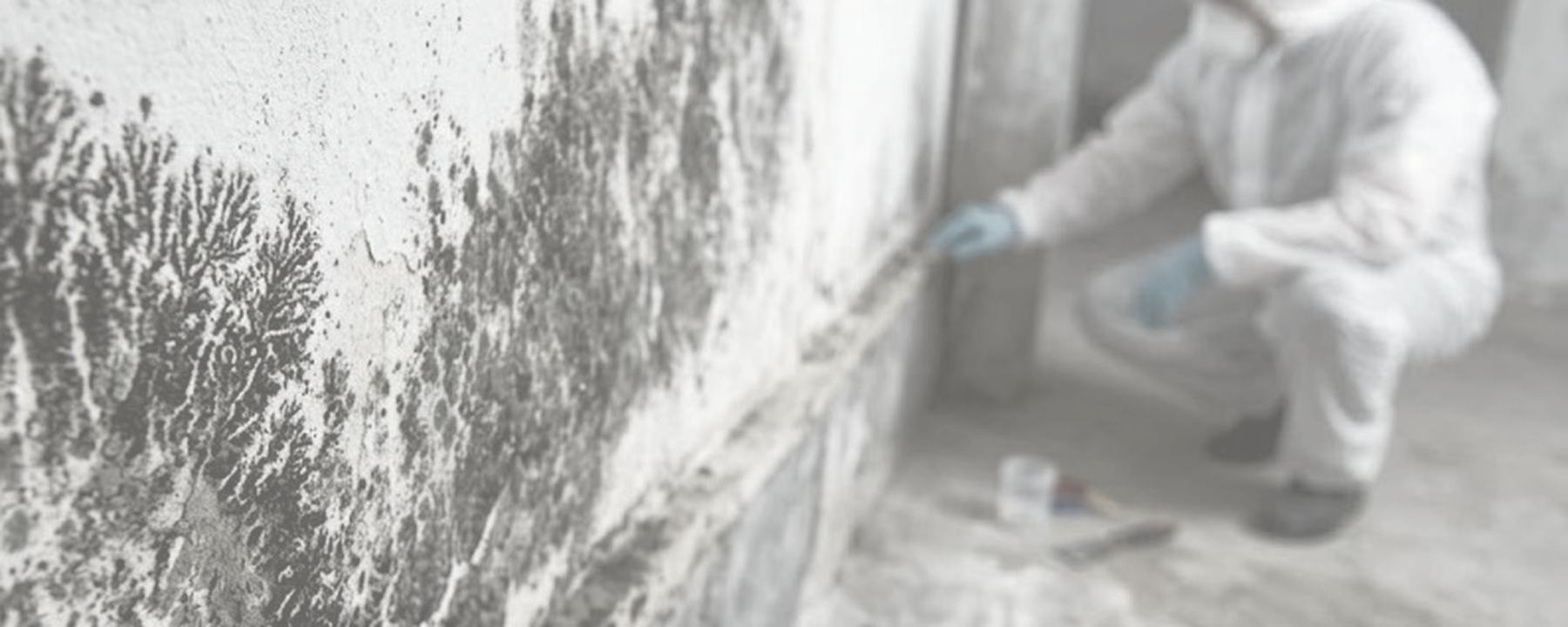
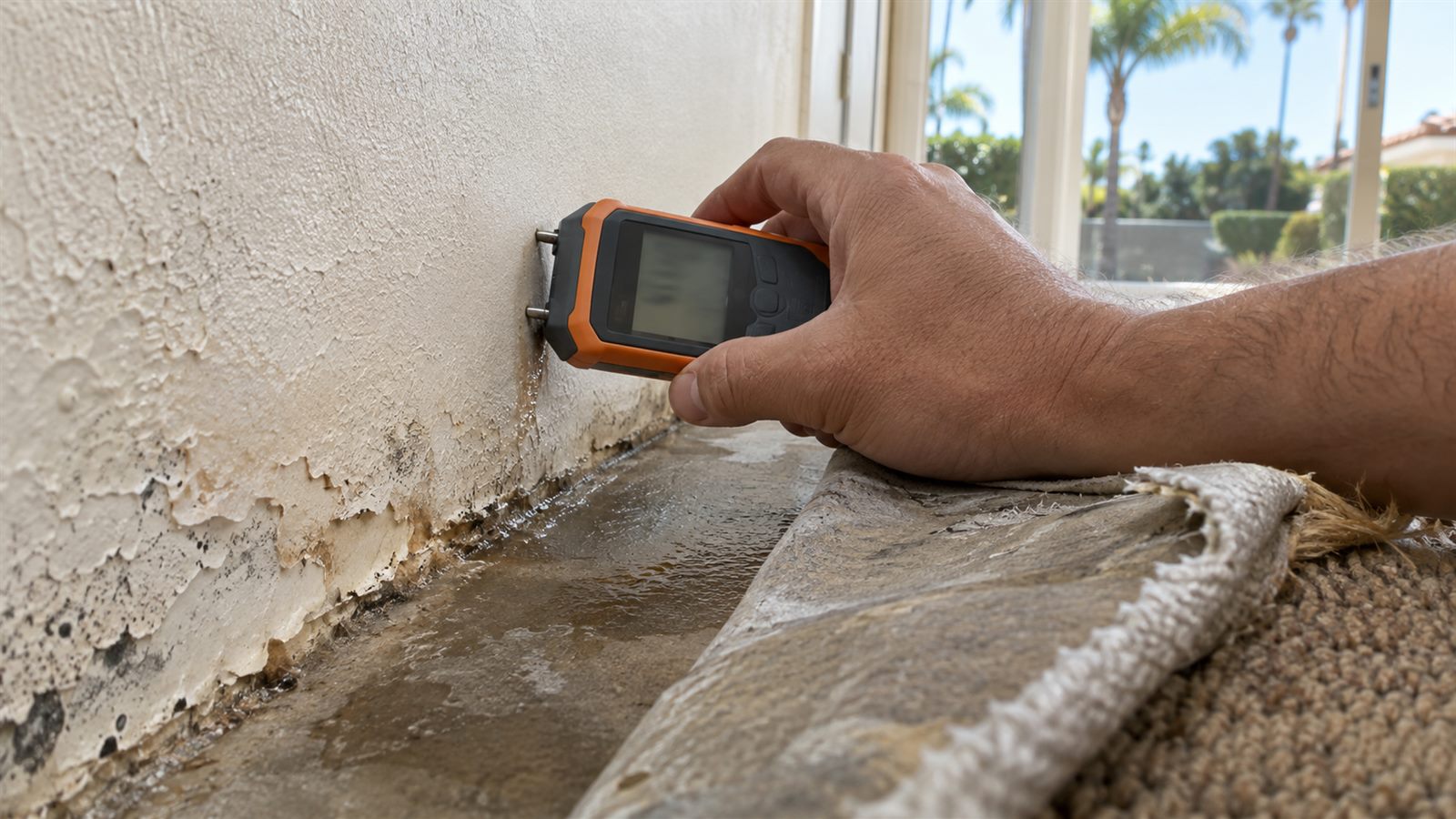
Specialist inspecting mold growth at the base of a wall in a San Diego home
Growth at the base of a wall with no fixture above it is the classic San Diego slab-leak signature. The water has usually been there for months.
The coastal strip
Marine-layer humidity at 80–90% on summer mornings, in homes with no air conditioning. Mold grows with no leak at all.
The mesas and suburbs
Fifty-to-seventy-year-old copper in slabs, failed hot-mopped shower pans, second-floor laundry over living space.
The inland valleys
Evaporative coolers adding twenty points of humidity indoors, plus heavy condensation from 30-degree day-to-night swings.
The flood corridors
River valleys and creek corridors that took record water in January 2024. Contaminated water means removal, not drying.

Construction & climate

What your house is made of, and what the climate does to it

Six construction eras cover almost all San Diego housing, and each one has a different weak point. Find yours — it tells you where to look before anyone opens a wall.

Pre-1940San Diego
Built with
Craftsman and Spanish Revival on a raised floor over a vented crawl space. Old-growth redwood and Douglas fir framing, shiplap sheathing, lath and plaster, cast-iron waste lines and galvanised steel supply. No insulation, no vapour retarder, no mechanical ventilation.
What the climate does to it
This assembly only stays dry because air moves continuously under the floor. A century of added patios, driveways, side-yard concrete and raised planters has blocked or buried the foundation vents on most of these lots. On the coast the marine layer then keeps the crawl space soil damp from May to September, and the cool underside of the subfloor becomes the condensing surface.
Where the mold forms
Underside of the subfloor and the floor joists, the bottom of wall plates, any insulation added later, and the soil-facing side of the stem wall.
What you notice first
A musty smell in the lowest rooms and in closets, months before anything is visible. Floors that feel cold, soft or springy. Hardwood cupping along one wall line.

Typical of: North Park, Ocean Beach, Golden Hill, Mission Hills, La Mesa Village, Old Town National City, Old Escondido, South Oceanside, Coronado Village

1940s–1950sSan Diego
Built with
The first large slab-on-grade tracts, plus the last of the raised-floor builds. Galvanised steel supply piping, cast-iron drains, hot-mopped shower pans, single-wall construction in rear additions, and in almost every case no under-slab vapour retarder.
What the climate does to it
Galvanised pipe corrodes from the inside and fails at threads and fittings after sixty to eighty years — which is now. Where the water table is shallow, the un-retarded slab wicks ground moisture continuously, and the mild coastal climate means the wall base never gets a drying cycle.
Where the mold forms
Inside wall cavities at failed pipe joints; along the bottom edge of drywall and behind baseboard where the slab wicks; under flooring adhesive.
What you notice first
Swollen or separating baseboard with no plumbing fixture nearby; flooring that lifts along one wall; a water bill that stepped up and never came back down.

Typical of: Clairemont's earliest blocks, Lemon Grove, western Chula Vista, National City, parts of Point Loma and Encanto

1950s–1970sSan Diego
Built with
San Diego's great suburban build-out. Slab-on-grade with soft copper supply lines run in or under the slab, low-slope composition roofs, single-pane aluminium windows, hot-mopped shower pans, original foundation and attic venting — and no air conditioning, because the climate never demanded it.
What the climate does to it
Soft copper in contact with concrete and soil corrodes from the outside in over roughly fifty to seventy years, so an entire generation of homes reached pinhole failure at the same time. With no mechanical cooling, indoor humidity simply tracks the marine layer: coastal mornings at 80–90% relative humidity for months. Inland, the same houses got evaporative coolers, which add water vapour to indoor air on purpose.
Where the mold forms
At the base of interior walls far from any fixture, because slab-leak water travels laterally under the flooring; behind shower tile where the hot-mopped pan has failed; in closets on north-facing exterior walls where nothing is leaking at all.
What you notice first
A patch of floor that is warm underfoot. The water meter's low-flow dial moving with every tap shut. Mold in a closet with no plumbing anywhere near it.

Typical of: Clairemont, Bay Park, Serra Mesa, Allied Gardens, Point Loma's Fleetridge and Wooded Area, Chula Vista's Castle Park, El Cajon's valley floor, Lemon Grove, La Mesa

1970s–1980sSan Diego
Built with
Planned-community tract housing: stucco over wood frame on slab, concrete tile roofs, aluminium sliders, original copper, early plastic supply piping in some tracts, and attics vented through soffit and ridge. Bathroom extract fans appear — but are very often ducted into the attic rather than through the roof.
What the climate does to it
Stucco is a reservoir cladding: it absorbs rain and holds it, and the wall depends on the drainage plane and flashings behind it. San Diego's ten inches of rain arrive in a handful of atmospheric rivers, so a flashing defect does nothing for eight months and then takes two inches in a day. Meanwhile every shower in a fan-ducted-to-attic bathroom deposits two to three pints of water onto the roof sheathing.
Where the mold forms
Roof sheathing above bathrooms, diffuse rather than in one stain; inside stucco walls below corroded window-head flashing; at the slab edge from pinhole copper leaks.
What you notice first
Dark diffuse growth across the attic deck. A bathroom ceiling stain that comes back after painting. An interior wall stain two to four feet below the window above it.

Typical of: Mira Mesa, Tierrasanta, Scripps Ranch, Rancho Bernardo's original villages, Poway, Santee, University City, Rancho Peñasquitos, Oceanside's inland tracts

1990s–2000sSan Diego
Built with
Two-storey production stucco with complex rooflines, concrete tile, second-floor bathrooms and laundry rooms over living space, bigger glazing, and ducts run through unconditioned attics. Kick-out flashing at roof-to-wall junctions was widely omitted in this era.
What the climate does to it
Each roof-to-wall junction concentrates the drainage of a whole roof plane at one point. Without the small kick-out diverter, every atmospheric river sends that stream behind the stucco. On the coast, the marine layer then prevents the cavity from drying between storms; inland, Santa Ana heat bakes the moisture deeper into the framing before winter returns.
Where the mold forms
A concealed wet column inside the wall at the roof-wall junction, often surfacing a full storey lower; the ceiling and wall below a second-floor bathroom or laundry; duct runs sweating in a humid attic.
What you notice first
Ground-floor staining with no plausible source above. A soft spot in a ceiling under an upstairs bathroom. Condensation marks following a duct line in the attic.

Typical of: Carlsbad's La Costa and Aviara, Encinitas Ranch, San Marcos, Chula Vista's Eastlake and Otay Ranch, Rancho del Oro in Oceanside, Scripps Highlands, 4S Ranch

2000s–2020sSan Diego
Built with
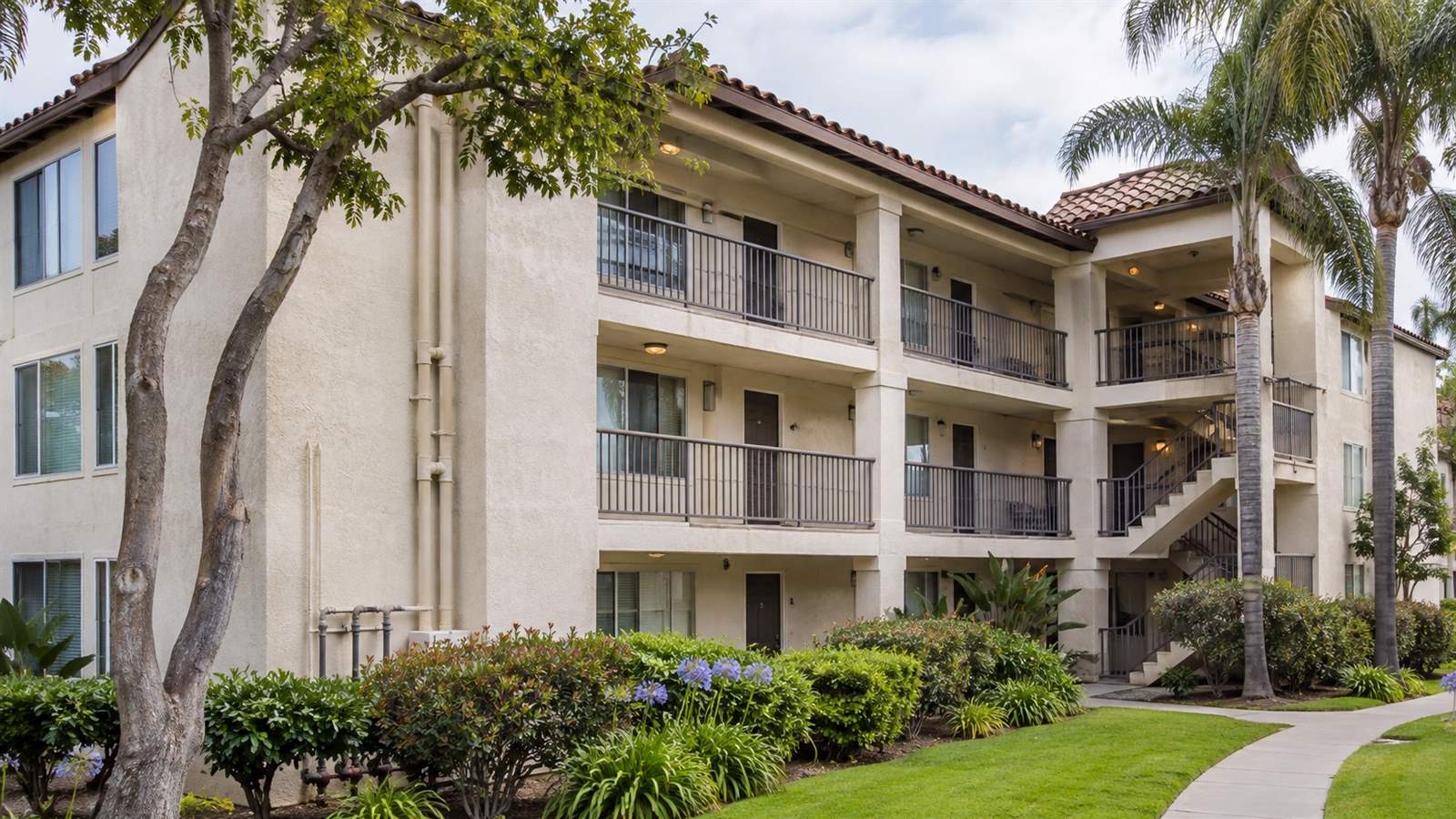
Tight, well-insulated envelopes with under-slab vapour retarders, engineered lumber, mechanical ventilation, and a great deal of attached housing — podium apartments and condominiums with wood frame over a concrete parking structure, shared plumbing risers and waterproofed decks over occupied rooms.
What the climate does to it
Capillary moisture and ambient humidity are largely designed out, so these buildings rarely grow mold from the climate alone. The trade-off is that a tight building does not dry itself: a leak that would have aired out in a 1950s house stays wet. Below-grade and podium parking at or near the water table runs high humidity year-round.
Where the mold forms
Behind laundry and kitchen walls at appliance connections; in floor assemblies under failed deck and walkway membranes; in ground-floor units and storage adjacent to podium parking.
What you notice first
Nothing for weeks, then a sudden large stain — tight assemblies hide water until the finish fails. A persistent damp smell in a ground-floor unit with no visible source.

Typical of: Downtown San Diego, Mission Valley's Civita and Riverwalk, Millenia in Chula Vista, Bressi Ranch, Del Sur, Pacific Station in Encinitas

Signs & symptoms

How you would know — including when there is nothing to see

Most mold in a San Diego property is not on a surface you can look at. It is behind stucco, under flooring, on the underside of a subfloor or inside a duct. Three ways it gives itself away.

What you can see

Discoloration that returns after painting
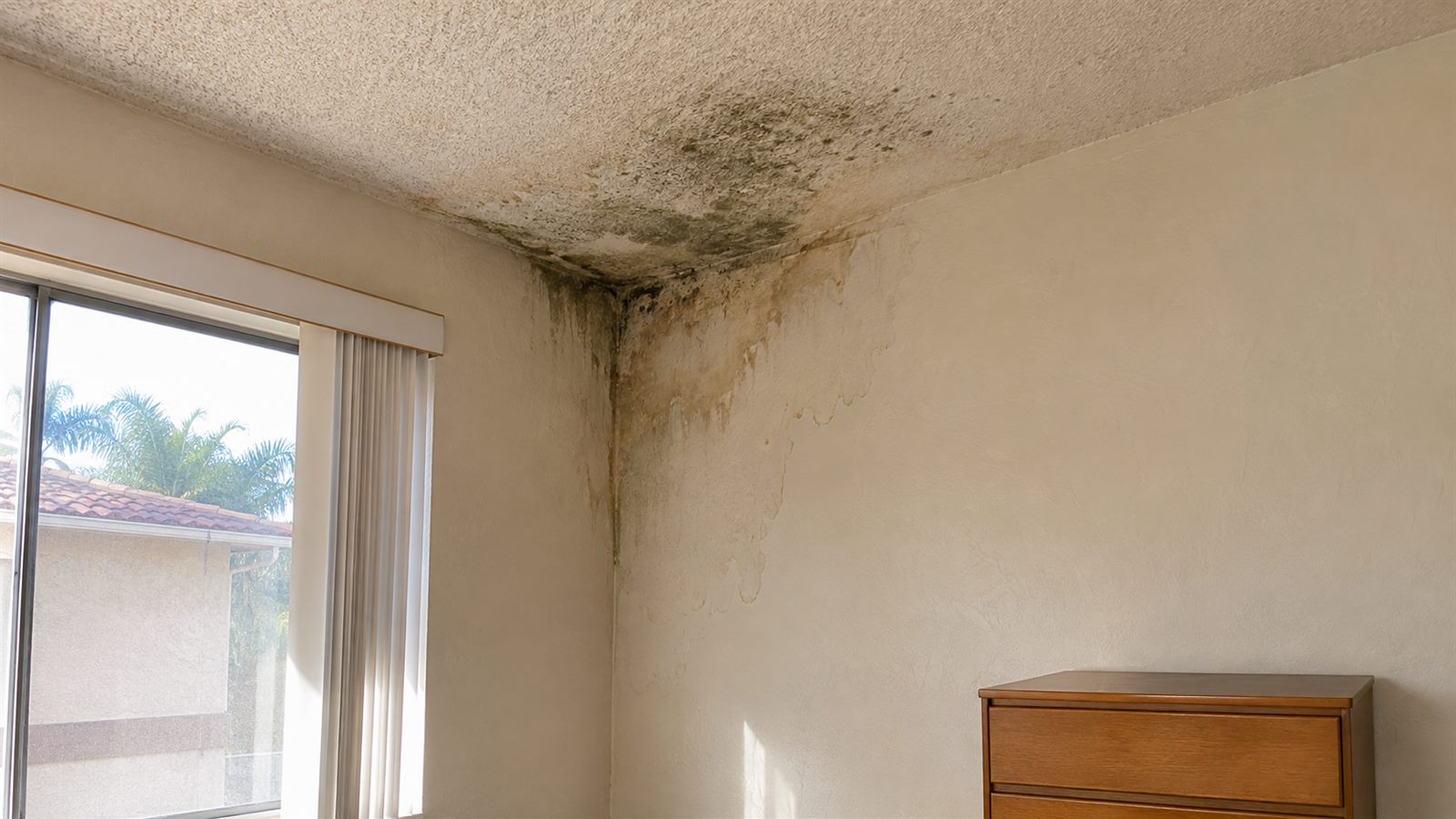
Paint does not stop mold. A stain that reappears within weeks means the material behind it is still wet and the organism is still alive in the substrate. Look at bathroom ceilings, the wall behind a shower, and the bottom 12 inches of walls in slab homes.
Swollen, lifting or separating baseboard
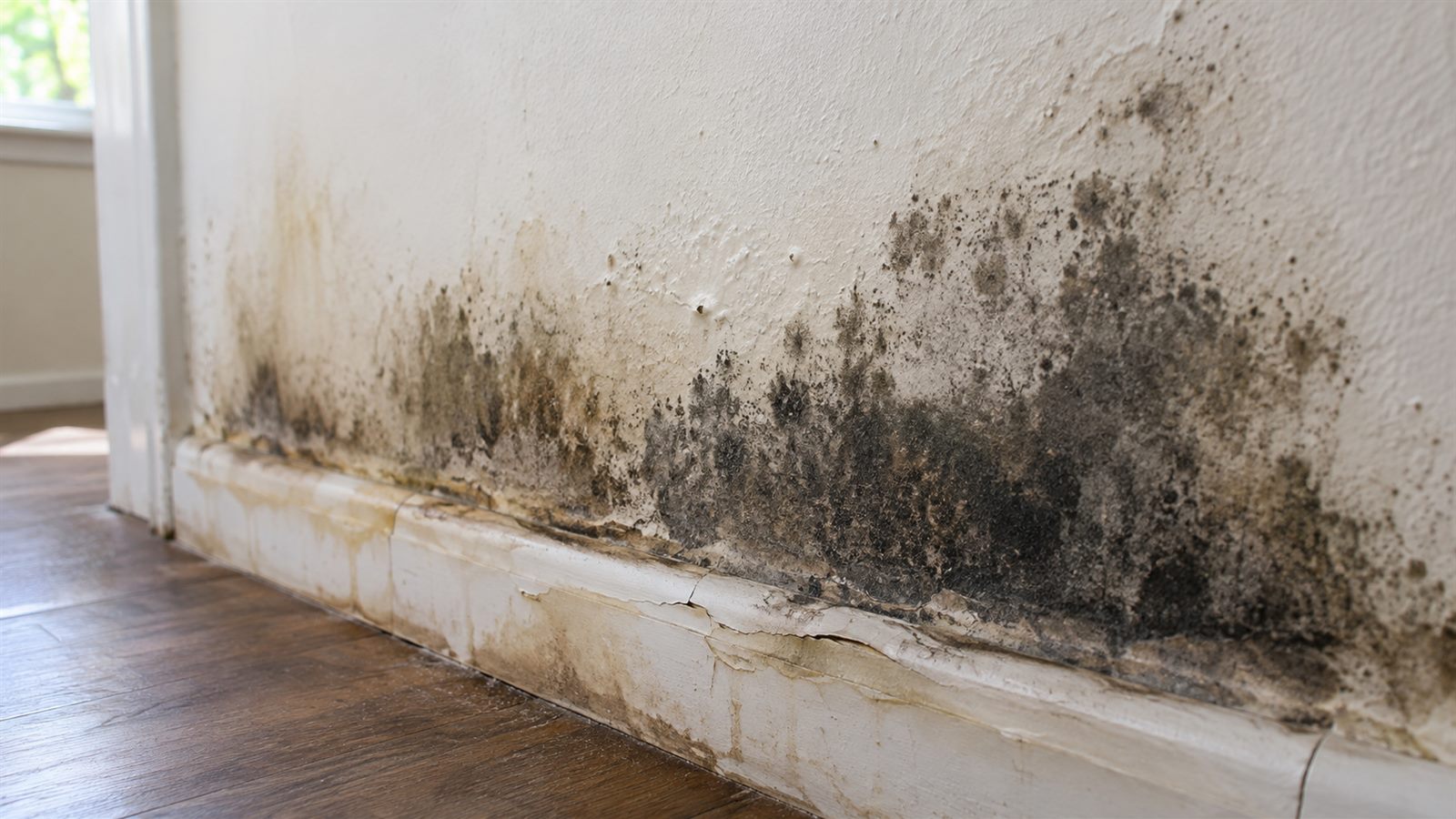
MDF and finger-jointed pine swell visibly when the bottom edge absorbs water. The telling version is baseboard damage on an interior wall with no plumbing fixture nearby — that is a slab leak surfacing far from the break.
Bubbling or blistering paint and stucco
Moisture moving through the substrate from behind. On exterior stucco, follow it upward: in San Diego's stucco-over-frame walls, water enters high at a window head or a missing kick-out flashing and surfaces low.
Flooring that cups, lifts or feels soft
Hardwood cupping along one wall line, vinyl lifting at a seam, tile that sounds hollow at the bottom course of a shower. All indicate the subfloor or slab beneath is wet.
Dark diffuse growth on attic sheathing
Spread across the deck rather than radiating from one point. That pattern is condensation, not a roof leak — almost always a bathroom fan terminating in the attic or soffit intake buried under blown insulation.
Visible colonies on a wet cellulose surface
Dark green-black growth on soaked drywall paper, cardboard, framing or ceiling tile. On cellulose this usually means weeks of continuous saturation, so the affected area is larger than what you can see.

What you cannot see, but can measure or smell

A musty smell with nothing visible
The single most reliable indicator of hidden growth. The odour is microbial volatile organic compounds from an actively growing colony, which means a wall cavity, a floor assembly, the crawl space or the duct system. In a raised-floor home it reaches you through floor penetrations; the smell is usually strongest in the morning and in the lowest rooms.
A smell that arrives when the system starts
If the odour appears within a minute of the blower starting and fades when it stops, the source is in the air handler, the condensate pan or the duct run — which in San Diego normally sits in a crawl space, an attic or a garage.
A warm patch on a slab floor
Walk the floors barefoot early, before sun or heating warms the concrete. A distinctly warm spot means a hot-water-side slab leak is heating the slab locally.
A water meter that moves with everything off
Shut every tap, appliance, irrigation valve and ice maker, then watch the meter's low-flow indicator for ten minutes. Any movement means water is escaping into the building or the ground. This costs nothing and catches most slab leaks.
A step change in the water bill
Pull twelve months. A jump at one billing period that never came back down, with no change in use, is strong evidence of a concealed leak rather than a habit.
Humidity that stays above 60%
A $15 hygrometer tells you more than your eyes. Sustained indoor relative humidity above about 60% means cool surfaces — closet walls, the back of furniture against an exterior wall — are reaching a surface humidity that supports growth with no leak at all. That is the normal coastal San Diego condition from May to September.

What we do

Mold services across San Diego County

Eighteen services, all dispatched county-wide. If you are not sure which one you need, call and describe what you are seeing.

Mold Removal Process in San Diego

What actually happens in your house, day by day — containment, what comes out, how long you live with the equipment.

Mold Removal Process

Mold Remediation in San Diego

Full IICRC S520 containment, HEPA filtration, controlled removal and post-remediation verification.

Mold Remediation

Mold Inspection and Testing in San Diego

Moisture mapping, thermal imaging, cavity probes and accredited lab analysis of air and surface samples.

Mold Inspection and Testing

Black Mold Removal in San Diego

Stachybotrys and other dark toxigenic colonies removed under negative-pressure containment.

Black Mold Removal

Water Damage Restoration in San Diego

Emergency extraction, structural drying and documented moisture readings before mold can start.

Water Damage Restoration

Emergency Mold Removal in San Diego

24/7 response for burst pipes, slab leaks, storm flooding and sewage backups across San Diego County.

Emergency Mold Removal

Mold Removal Cost in San Diego

Real San Diego price ranges by room, by square foot and by scope — and what moves the number.

Mold Removal Cost

Crawl Space Mold Removal in San Diego

Sub-floor mold removal, vapor barrier replacement and crawl space encapsulation.

Crawl Space Mold Removal

Attic Mold Removal in San Diego

Roof-deck mold treatment, soffit and ridge ventilation correction, insulation replacement.

Attic Mold Removal

Not sure which one you need?

Call (858) 400-3506

Our process

How a MoldFixer job runs

  1. Free phone consultation

    You describe it. We tell you how urgent it is, what it most likely is, and whether you need an inspection or a same-day dispatch. No charge.

  2. Inspection and moisture mapping

    Moisture meters, thermal imaging, humidity readings and borescope access through small openings. We define the actual wet boundary rather than guessing at it.

  3. Written scope and price

    What comes out, what gets cleaned, what equipment runs and for how long, and the number. Insurance documentation built from the start if a carrier is involved.

  4. Containment and HEPA filtration

    Sealed barriers and negative air pressure so the rest of the building stays usable. This is what stops demolition spreading spores through the house.

  5. Removal, drying and daily logs

    Porous material out, salvageable material cleaned and treated, then dehumidification until readings reach the dry standard — logged every day.

  6. Verification and source correction

    Nothing closes until the readings pass. Then the plumbing, flashing, grade or ventilation fix that stops it coming back.

Why MoldFixer

Why people call us first

1

A real conversation before anyone is sent out

You get a straight read on how urgent it is and what it most likely is. A good share of these calls end with “check your bathroom fan and call back if it does not improve” — and that is a successful call.

2

Matched to the right specialist, not the nearest one

A 1920s Ocean Beach crawl space and a 1970s Clairemont slab leak are different jobs. You get someone who works your area and your property type, and your details are not sold on to a list.

3

Published price ranges, written estimates

Indicative ranges are on every page so you know whether this is a $1,500 problem or a $15,000 one. The binding number is the written estimate you get after someone has actually seen the property.

4

The paperwork that matters later

Photographs, daily moisture logs, source determination and post-remediation verification — the close-out package an insurer, a buyer or an HOA will ask for.

More detail on how MoldFixer works, including the standards the work is measured against and how a specialist gets onto this line.
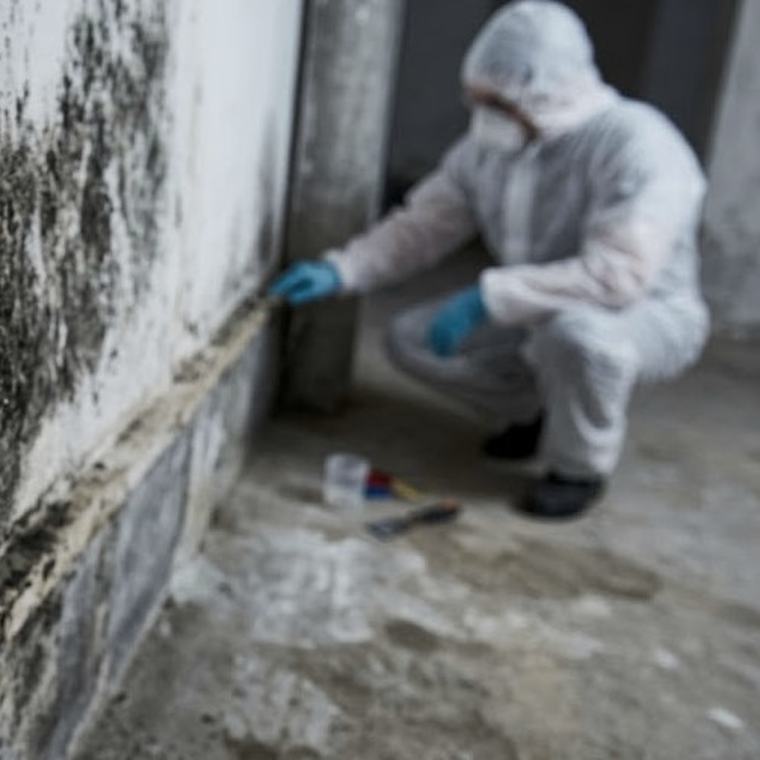
Mold specialist inspecting a wall in a San Diego property
Containment, controlled removal and documented drying, to the IICRC S520 standard. Photograph shows a model.

Pricing

What mold removal costs in San Diego

Remediation and drying only. Reconstruction and plumbing repair are quoted separately.
ScopeSan Diego cost rangeDuration
Small contained area under 10 sq ft$500 – $1,4001 – 2 days
Single bathroom, wall and subfloor$1,400 – $3,5002 – 4 days
One room after a contained leak$1,800 – $4,5003 – 5 days
Crawl space, removal and new barrier$2,200 – $6,5003 – 6 days
Attic sheathing and insulation$1,800 – $4,8002 – 5 days
Slab-leak condition, multiple wall bases$3,500 – $8,5004 – 8 days
Whole unit after a long-running loss$8,000 – $20,000+1 – 3 weeks

Indicative ranges for guidance only — not a quote. Every property is different, and a written estimate follows an on-site assessment.

Full breakdown by room, by square foot and by water category on mold removal cost in San Diego.

Guides

Recent guides

Water & damage

Water damage: what to do in the first 24 hours

An hour-by-hour guide to the first day after water damage in a San Diego home: what to do, what not to touch, and why the 24-hour window decides the cost.

November 7, 2026 · 9 min read

Legal & rights

Condo mold: who pays, the owner or the HOA?

How responsibility for condo mold is decided in California: common elements, CC&Rs, Davis-Stirling, HO-6 policies, and the one document that settles it.

November 7, 2026 · 9 min read

All 24 San Diego mold guides →

San Diego mold removal: frequently asked questions

How much does mold removal cost in San Diego?

Most San Diego residential mold removal falls between $1,400 and $8,500, with a county median around $3,200. A single bathroom is typically $1,400 to $3,500, a crawl space scope $2,200 to $6,500, and a slab-leak condition $3,500 to $8,500 for remediation and drying. The driver is how long the water was present and how far it travelled, not the size of the visible patch. Call (858) 400-3506 for a scoped range before anyone visits.

Why does San Diego have mold if the climate is dry?

Because mold responds to sustained moisture at a material surface rather than to rainfall. The marine layer holds coastal morning relative humidity at 80 to 90 percent for much of May through September, and most coastal homes have no air conditioning or dehumidification. Inland, evaporative coolers add water vapor directly to indoor air. Across the suburbs, fifty-to-seventy-year-old copper in slabs leaks hidden water year round. Ten inches of rain is almost irrelevant to any of it.

How fast does mold grow after a leak in San Diego?

Mold begins colonising wet drywall and fibreglass insulation within 24 to 48 hours at normal indoor temperatures, and San Diego interiors sit in the ideal range year round. That window is why clean water caught on day one can often be dried in place, while the same water at 72 hours usually means removing drywall, insulation and flooring — frequently several times the cost.

Do I need mold testing before mold removal?

Often not. If mold is visible and you know where the water came from, a species panel will not change the containment design, the removal boundary or the drying standard. Testing earns its cost in four situations: you smell it but cannot find it, there is a dispute with a landlord, insurer, HOA or seller, someone in the home is symptomatic and you need a baseline, or you want independent clearance after remediation.

Does homeowners insurance cover mold in California?

Usually when the mold results from a sudden accidental covered event such as a burst supply line, an appliance failure or a storm-driven roof breach. Usually not when it results from long-term seepage, maintenance, condensation, groundwater or flooding — flood needs a separate policy. Even where covered, many California policies sublimit the mold portion at $5,000 to $10,000. Documentation from day one is what decides claims in practice.

Do you serve all of San Diego County?

Yes — 34 dedicated service areas from Imperial Beach and Coronado up the coast to Oceanside, through urban San Diego and the mesas, the South Bay, East County and inland North County to Poway, Escondido, San Marcos and Vista. Same-day dispatch for active water intrusion, typically 24 to 48 hours for a non-emergency inspection.

Can I stay in the house during mold remediation?

Usually yes. Containment with negative air pressure and HEPA filtration is designed specifically so the rest of the building stays usable, and most of our residential work happens in occupied homes. We recommend relocating when the containment covers the only bathroom or kitchen, when most of the home is affected, or when an occupant is immunocompromised, severely asthmatic, pregnant, elderly or an infant.

Will the mold come back?

Only if the water source was not corrected. Properly removed material in a properly dried assembly does not regrow unless it gets wet again. That is why our close-out always identifies the source — the plumbing, the flashing, the grade, the blocked crawl space vent, the bathroom fan ducted into the attic — and why we will say plainly when something must be fixed before the wall goes back.

Before you dial

What to have ready when you call

Your address or cross streets
It tells us the likely build era and moisture profile before anyone arrives. A 1920s Ocean Beach cottage and a 1970s Clairemont slab home get different first questions, and the answer often changes what you should do today.
What you are seeing, smelling or feeling
Visible growth, a stain, a musty smell, soft flooring, swollen baseboard, a warm patch on the floor, symptoms that ease when you leave the house. Where in the building, and in which rooms.
When it started and what changed
A leak, a storm, a remodel, a re-roof, a new appliance, a season change. The history narrows the cause faster than any instrument does.
Whether water is still moving
This is the single question that decides whether you need someone today or an appointment this week. Mold begins colonising wet gypsum within 24 to 48 hours, so an active leak is a different conversation.
Who is in the building
Infants, elderly occupants, anyone asthmatic or immunocompromised. It changes the urgency and what we recommend you do in the meantime.
Whether it is a rental, a condo or owner-occupied
It changes the documentation you will need. In a rental the written notice matters from day one; in a condominium you need a source determination before anyone repairs anything, because that is what decides who pays.

Contact

Get a free phone consultation

Tell us what you are seeing and we will tell you what it most likely is, how urgent it is and roughly what the work involves. If your situation does not need anyone sent out, you will be told that on the call.

Response
Same-day dispatch for active water intrusion
Non-emergency
Inspection usually within 24 – 48 hours
Coverage
All 34 San Diego County service areas
Languages
English and Spanish
Call 24/7(858) 400-3506Email[email protected]
ServingSan Diego County, California
Hours24 hours, 7 days, including holidays

Mold or water damage in San Diego?

Call now for a free phone consultation. The line is answered 24 hours a day and we dispatch same-day anywhere in San Diego County when water is still active.

(858) 400-3506

No cost to call · no obligation · 24/7
(858) 400-3506 See price ranges